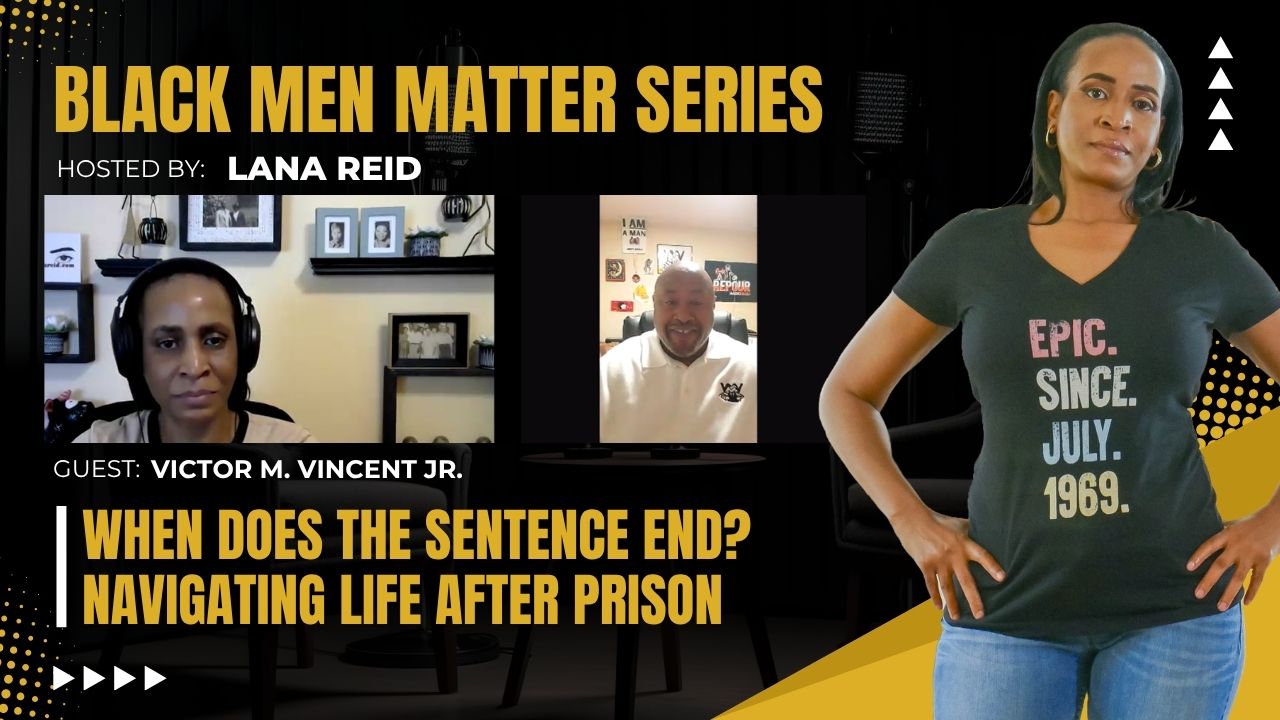
When Does the Sentence End? Navigating Life After Prison | Victor M. Vincent Jr.
By Lana Reid | September 30, 2026
Publication Information
| Interviewee | Victor M. Vincent Jr. |
|---|---|
| Interviewer | Lana Reid |
| Collection | The Male Perspective: Black Men Matter Oral History Collection |
| Interview No. | 234 |
| Publisher | Conversations in Color |
| Rights Holder | Conversations in Color (501(c)(3)) |
| Original Format | Recorded Video Interview |
| Language | English |
| Original Air Date | September 30, 2026 |
| Publication Date | September 2026 |
| Location | Virtual Interview |
| DOI | https://doi.org/10.5281/zenodo.23068958 |
As part of the Black Men Matter Series, Lana Reid sits down with Victor M. Vincent Jr., Founder and President of The ReEntry Expert, for a conversation about what happens after a person has served their sentence but continues to encounter the consequences of incarceration. Drawing from his own journey returning to his community and his work helping others navigate reentry, Victor examines the interconnected roles of education, employment, higher education, and community support in successfully rebuilding a life after prison. From the importance—and difficulty—of obtaining a GED to the realities of finding employment with a criminal record, the conversation asks a larger question: When society says someone deserves a second chance, when does the sentence actually end?
In this episode of The Male Perspective, Victor M. Vincent Jr. offers a firsthand look at reentry and the many moving pieces that can determine whether someone successfully rebuilds a life after incarceration.
Victor shares parts of his own journey and the challenges he encountered returning to his community. His experience illustrates that release from prison does not automatically mean freedom from the consequences of incarceration. A criminal record can continue affecting education, employment, financial stability, and access to opportunities long after an individual has completed the sentence imposed by the court.
One of the central topics of the conversation is education, beginning with something that can easily be taken for granted: obtaining a GED.
Victor discusses the importance of a GED for currently and formerly incarcerated individuals and why earning the credential can present significant obstacles. Without it, opportunities for employment, additional training, and higher education can become even more limited. Obtaining the credential can therefore represent much more than completing an educational requirement—it can become an important building block in creating a viable path forward.
But having the necessary credentials does not eliminate every barrier.
Lana Reid and Victor examine employment after incarceration and what society really means when it uses language such as “second chance.” Finding a job is one challenge; finding employment that offers sufficient wages, stability, benefits, and an actual opportunity to build a sustainable life can be another.
The conversation raises an important distinction between giving someone access to a job and providing access to the kinds of employment opportunities that allow a person to genuinely establish stability.
Victor also discusses the obstacles formerly incarcerated individuals can encounter when pursuing higher education. Together, these educational and employment barriers demonstrate why successful reentry cannot be reduced to a person’s motivation alone. Individuals may be committed to rebuilding their lives while simultaneously navigating systems and restrictions that continue to remind them of their past.
Drawing from both lived experience and his work through The ReEntry Expert, Victor offers another perspective on how reentry programs themselves could improve: listen more closely to the people preparing to come home.
People who have experienced incarceration can identify practical challenges, gaps in services, and needs that may not be apparent to those designing programs from outside the reentry experience. Including those voices in the conversation can help move support beyond assumptions about what formerly incarcerated individuals need and toward resources that reflect the realities they will actually encounter.
The discussion ultimately complicates the idea of a second chance. If a person serves the sentence required of them but continues to encounter restrictions that affect education, employment, housing, and other opportunities, the consequences of incarceration can extend far beyond the prison walls.
Victor closes the conversation by speaking directly to young Black men.
His message emphasizes how a decision that may appear small or momentary can result in incarceration and create consequences lasting far longer than the original sentence. What happens in a matter of minutes can affect educational opportunities, career options, financial stability, family life, and the trajectory of years to come.
At the same time, Victor’s own life demonstrates that a criminal record does not have to become the entirety of a person’s identity or determine everything that follows.
This episode asks us to think more deeply about reentry—not simply as the moment someone walks out of prison, but as the long process of rebuilding a life afterward, and about what a society that genuinely believes in second chances must make possible for people trying to move forward.
About the Guest
Victor M. Vincent Jr. is the Founder and President of The ReEntry Expert. Drawing from his own experience with incarceration and reentry, Victor works to help currently and formerly incarcerated individuals navigate the educational, employment, and practical challenges associated with returning to their communities and rebuilding their lives.
His work brings lived experience into conversations about reentry and emphasizes the importance of listening to people directly affected by incarceration when developing programs and resources intended to support them.
𝗙𝗼𝗿 𝗺𝗼𝗿𝗲 𝗶𝗻𝗳𝗼𝗿𝗺𝗮𝘁𝗶𝗼𝗻 𝗼𝗻 𝗩𝗶𝗰𝘁𝗼𝗿 𝗠. 𝗩𝗶𝗻𝗰𝗲𝗻𝘁 𝗝𝗿.:
https://www.thereentryexpert.org/
https://www.facebook.com/TheReEntryExpert
https://www.instagram.com/the_re_entry_expert
About the Series
This episode is part of the Black Men Matter Series, highlighting the voices and lived experiences of Black men across professions, communities, backgrounds, and generations while creating space for them to tell their stories in their own words.
About the Host & Organization
The Male Perspective is hosted by Lana Reid, founder of Conversations in Color, a nonprofit 501(c)(3) grassroots organization dedicated to providing uplifting and community-building spaces of dialogue for Black voices.
Conversations in Color’s Current Initiatives
THE MALE PERSPECTIVE
The purpose of The Male Perspective is to dispel stereotypes and increase awareness of the experiences of Black men through open discussions, thought-provoking interviews, and the sharing of personal experiences that highlight the diversity and depth of the Black male experience.
SISTAS REBUILDING SISTERHOOD
Sistas Rebuilding Sisterhood is an intergenerational community of Black women who come together for relaxed, non-judgmental gatherings to exchange ideas, share experiences, and collaborate in a collective effort to improve the quality of sisterhood interactions in everyday life.
TAPESTRY OF BLACK VOICES AWARDS
The Tapestry of Black Voices Awards honors local communities and showcases the creativity, brilliance, and lived experiences of Black voices across the United States.