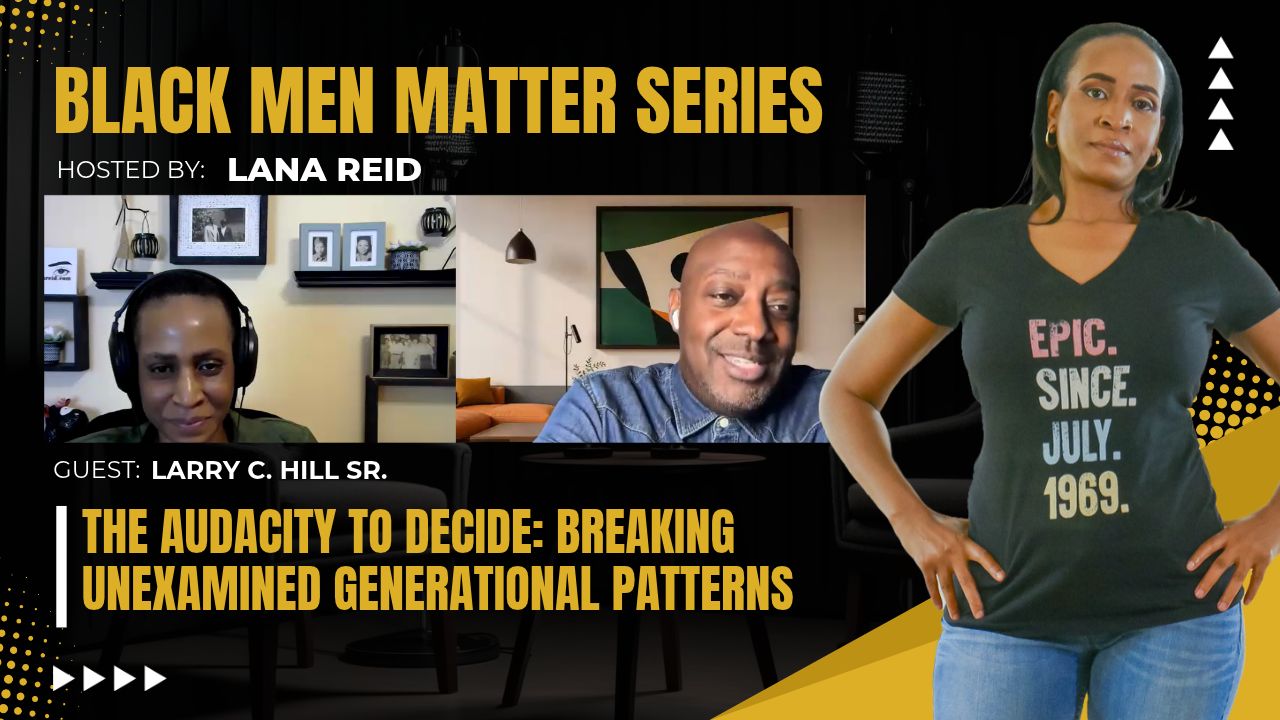
The Audacity to Decide: Breaking Unexamined Generational Patterns | Larry C. Hill Sr.
By Lana Reid | October 7, 2026
Publication Information
| Interviewee | Larry C. Hill Sr. |
|---|---|
| Interviewer | Lana Reid |
| Collection | The Male Perspective: Black Men Matter Oral History Collection |
| Interview No. | 235 |
| Publisher | Conversations in Color |
| Rights Holder | Conversations in Color (501(c)(3)) |
| Original Format | Recorded Video Interview |
| Language | English |
| Original Air Date | October 7, 2026 |
| Publication Date | October 2026 |
| Location | Virtual Interview |
| DOI | https://doi.org/10.5281/zenodo.23222407 |
As part of the Black Men Matter Series, Lana Reid sits down with Larry C. Hill Sr., author of The Audacity to Decide and founder of the 5230 Movement, for a conversation about the patterns men inherit, the decisions they make, and what happens when survival begins to look like strength. Inspired by a conversation with his son that challenged him to look inward, Larry examines the inner voices, beliefs, expectations, and behaviors men can carry from one generation to the next without ever stopping to question where they originated. Drawing from profound losses in his own life—including the murder of his father, the death of his daughter, and the ending of a marriage—Larry explores what can happen when a man who has learned to keep functioning finally begins examining what is happening beneath the surface.
In this episode of The Male Perspective, Larry C. Hill Sr. introduces a deceptively simple idea: “Every decision has an author.”
Who—or what—is authoring the decisions you make?
For Larry, that question became increasingly important after a conversation with his son challenged him to look inward. The exchange became part of the motivation behind his book, The Audacity to Decide, and the larger work he now does through the 5230 Movement.
The conversation explores the patterns that shape how men move through life, including beliefs and internal voices that may have been inherited long before a man ever consciously chose them. Some come from family. Others are connected to experiences, expectations, loss, survival, and what men have been taught strength is supposed to look like.
Generations of men have learned how to provide, protect, lead, endure, and keep moving forward. Those qualities can be necessary and valuable. But Larry asks what happens when the ability to keep functioning also allows grief, fear, uncertainty, and unresolved pain to remain hidden.
A man may still go to work. He may continue taking care of his family. He may make decisions, solve problems, fulfill responsibilities, and appear to everyone around him to be doing exactly what he is supposed to do.
And yet, internally, something may need to pivot.
That distinction between functioning and healing becomes an important part of Lana and Larry’s conversation. Survival can teach someone how to continue moving without necessarily giving them the opportunity—or language—to examine what they are carrying while they move.
Larry’s perspective comes from experiences that have required him to confront significant loss. He discusses the murder of his father, the death of his daughter, the ending of a marriage, and other life-changing experiences that became part of his own story. Rather than presenting strength as the absence of grief or struggle, he examines what it means to recognize when the ways a person has learned to survive are no longer enough.
That examination also requires looking backward.
Through his idea that “every decision has an author,” Larry encourages men to consider where their internal scripts originated. Which beliefs were intentionally chosen? Which were learned through observation? Which were passed down by parents, fathers, grandfathers, communities, or circumstances? And which patterns continue simply because nobody stopped long enough to question them?
This is where the conversation becomes intergenerational.
What one generation leaves unexamined can become something the next generation inherits. Behaviors and beliefs can travel through families without anyone consciously deciding that they should continue. Larry’s work challenges men to recognize that inheritance does not automatically create obligation.
Just because something was handed down to you does not mean you have to hand it down again.
Through the 5230 Movement, Larry creates opportunities for men to examine those patterns more intentionally. He discusses the movement’s 30-Day Pathway and self-assessment tools designed to help men look beneath outward performance and begin identifying what may be influencing their decisions, relationships, leadership, and sense of self.
The goal is not simply reflection for reflection’s sake. Recognizing a pattern creates an opportunity to decide what happens next.
That may mean keeping parts of what previous generations provided. It may mean modifying others. And sometimes it may mean deciding that something stops with you.
Ultimately, Larry’s conversation is not about rejecting the men who came before us or dismissing the survival strategies that helped previous generations endure their circumstances. It is about developing the awareness to distinguish between what helped them survive and what should continue into another generation.
That is where the audacity to decide becomes more than the title of a book. It becomes permission to examine what you inherited, understand what has been authoring your decisions, and consciously choose what deserves to travel forward.
About the Guest
Larry C. Hill Sr. is the author of The Audacity to Decide and founder of the 5230 Movement.
Through the 5230 Movement, Larry helps men examine the beliefs, internal voices, experiences, and generational patterns influencing how they navigate their lives. The movement includes a 30-Day Pathway and self-assessment tools intended to encourage reflection, accountability, and intentional decision-making.
Drawing from his own experiences with grief, loss, relationships, family, and personal transformation, Larry challenges men to look beneath their ability to function and consider whether the patterns they have inherited are helping them heal, keeping them in survival mode, or being unintentionally passed to the next generation.
𝗙𝗼𝗿 𝗺𝗼𝗿𝗲 𝗶𝗻𝗳𝗼𝗿𝗺𝗮𝘁𝗶𝗼𝗻 𝗼𝗻 𝗟𝗮𝗿𝗿𝘆 𝗖. 𝗛𝗶𝗹𝗹 𝗦𝗿.:
https://www.5230maninprogress.com/
https://www.facebook.com/thereallarrychill
https://www.amazon.com/Audacity-Decide-Autopilot-Deciding-Purpose-ebook/dp/B0HG421JP1
About the Series
This episode is part of the Black Men Matter Series, highlighting the voices and lived experiences of Black men across professions, communities, backgrounds, and generations while creating space for them to tell their stories in their own words.
About the Host & Organization
The Male Perspective is hosted by Lana Reid, founder of Conversations in Color, a nonprofit 501(c)(3) grassroots organization dedicated to providing uplifting and community-building spaces of dialogue for Black voices.
Conversations in Color’s Current Initiatives
THE MALE PERSPECTIVE
The purpose of The Male Perspective is to dispel stereotypes and increase awareness of the experiences of Black men through open discussions, thought-provoking interviews, and the sharing of personal experiences that highlight the diversity and depth of the Black male experience.
SISTAS REBUILDING SISTERHOOD
Sistas Rebuilding Sisterhood is an intergenerational community of Black women who come together for relaxed, non-judgmental gatherings to exchange ideas, share experiences, and collaborate in a collective effort to improve the quality of sisterhood interactions in everyday life.
TAPESTRY OF BLACK VOICES AWARDS
The Tapestry of Black Voices Awards honors local communities and showcases the creativity, brilliance, and lived experiences of Black voices across the United States.